
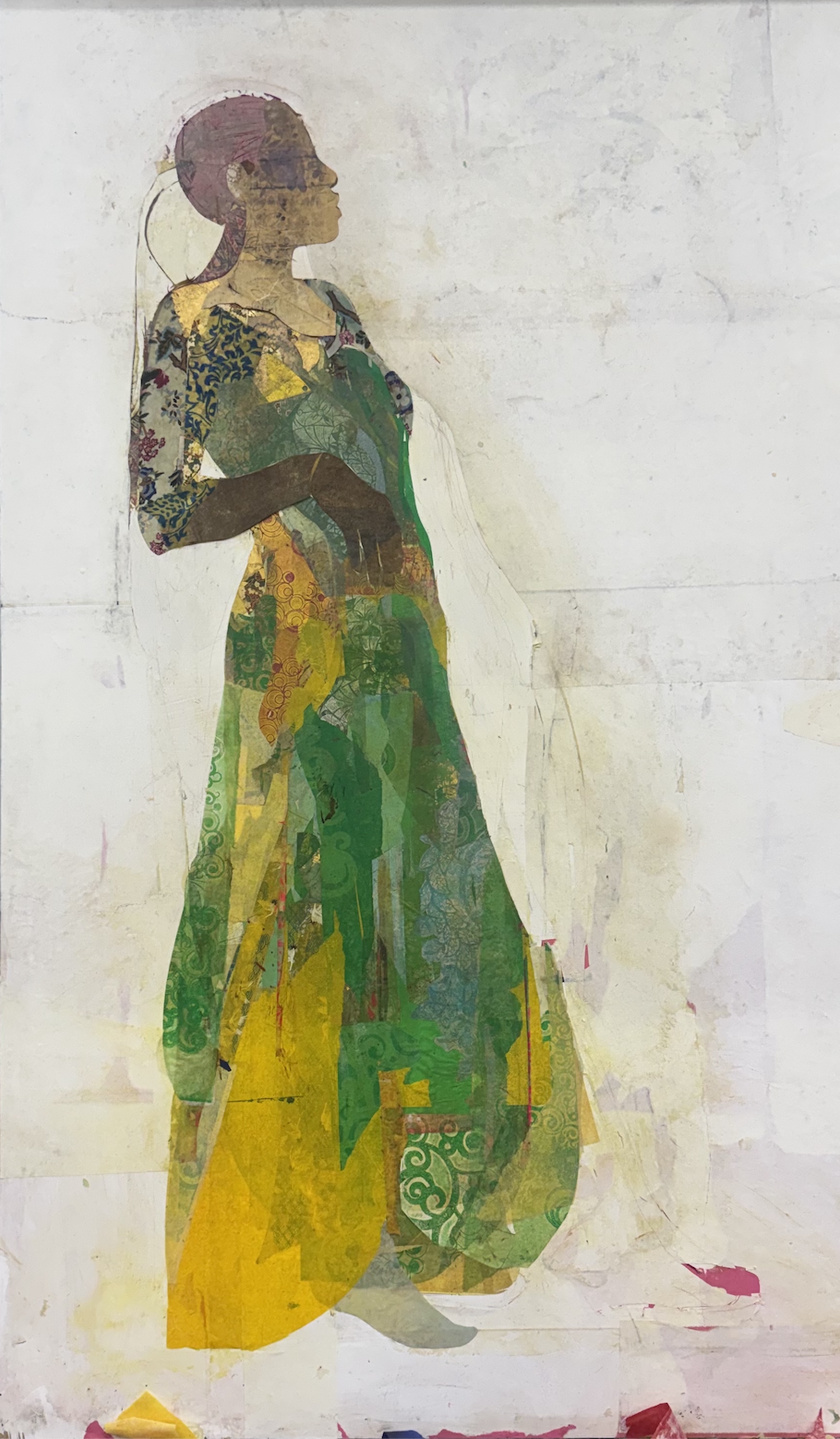
Volker Hamann & Jite Agbro: FORCE (Chase Young Gallery, Boston, September-October 2026)
The show brings together seemingly incompatible artists and materials. Volker Hamann, a native German and resident of Stuttgart, uses a chainsaw to carve on plexiglass; Jite Agbro, a Nigerian-American, resides in Seattle and her medium is decoupage from handmade prints on fabric and paper.
Yet, what they do to their materials, and the resulting effects, is intuitively comparable. The plexiglass panels are initially transparent, light, and flat. Hamann first drafts a rough pattern with a marker on the panel’s underside; then traces the contours with a full-size chainsaw (a deafening process!); then applies liquid pigments of his own invention—they change color at different angles—and finally seals the panel with acrylic paint to eliminate transparency. Agbro’s process begins with monotyping patterns on fabrics and kozo paper, very soft and tissue-thin: she needs to decoupage multiple layers to create a solid-looking shape. The pieces are ironed and infused with hot wax which similarly “seals” the image, albeit on the panel’s upside, not the underside like Hamann’s.
Thus, after numerous and perilous manipulations—many works fail midway— both artists mold their materials into the opposite of themselves. Plexiglass panels, a quarter-inch thick, turn into bottomless, three-dimensional, chameleonic pictures, while remaining light and smooth. Colorful scraps of tissue and fabric, as light as a butterfly’s wing, turn into solid, matte, full-length portraits on wooden panels, while retaining their initial transparency: one can literally peer through the wax and the top layers to the very bottom one.
Agbro, in her statements, has commented on the facelessness of her subjects. One might disagree: After all, decoupage operates with planes and angles, prohibiting complete flatness and solidity. As in an avant-garde portrait, her faces need to be guessed, but guessed they can be. There is no full anonymity, no complete effacement of individuality, which is what makes them fine art, rather than political posters. Hamann’s patterns, especially when regarded by series, may also appear grid-like, composed from identical segments, like wallpaper. It is not true, though: there is no repetition, no stenciling. Every stroke is different and stands for something unique: a strand of glass, a touch of hoar frost, a pine needle on the forest floor. All compositions in the show—it’s best uniting aspect—are charmingly uncertain but certainly guessable. (By Anna Friedrich)
How Printmaking Connects Jite Agbro to Her History and Heritage | Black Arts Legacies
100-plus artists convert the Pioneer Square building in Seattle into a huge art festival
Artist grieves for Central District childhood home by re-creating it|MAD Art Seattle